I
The materials
Power has a source.
Prepared inks, binders, and supernatural components are not interchangeable. A working depends on what goes into it, not merely the shape someone copies.
Urban fantasy · Occult noir · A series by R.B. Poulin
Infernal ink.
Dangerous bargains.
Family found in unlikely places.
Enter the world of Larissa Osborn, a tattoo witch raised by imps. Begin with No Such Thing As Nowhere, then follow the ink beyond the familiar world.
The beginning
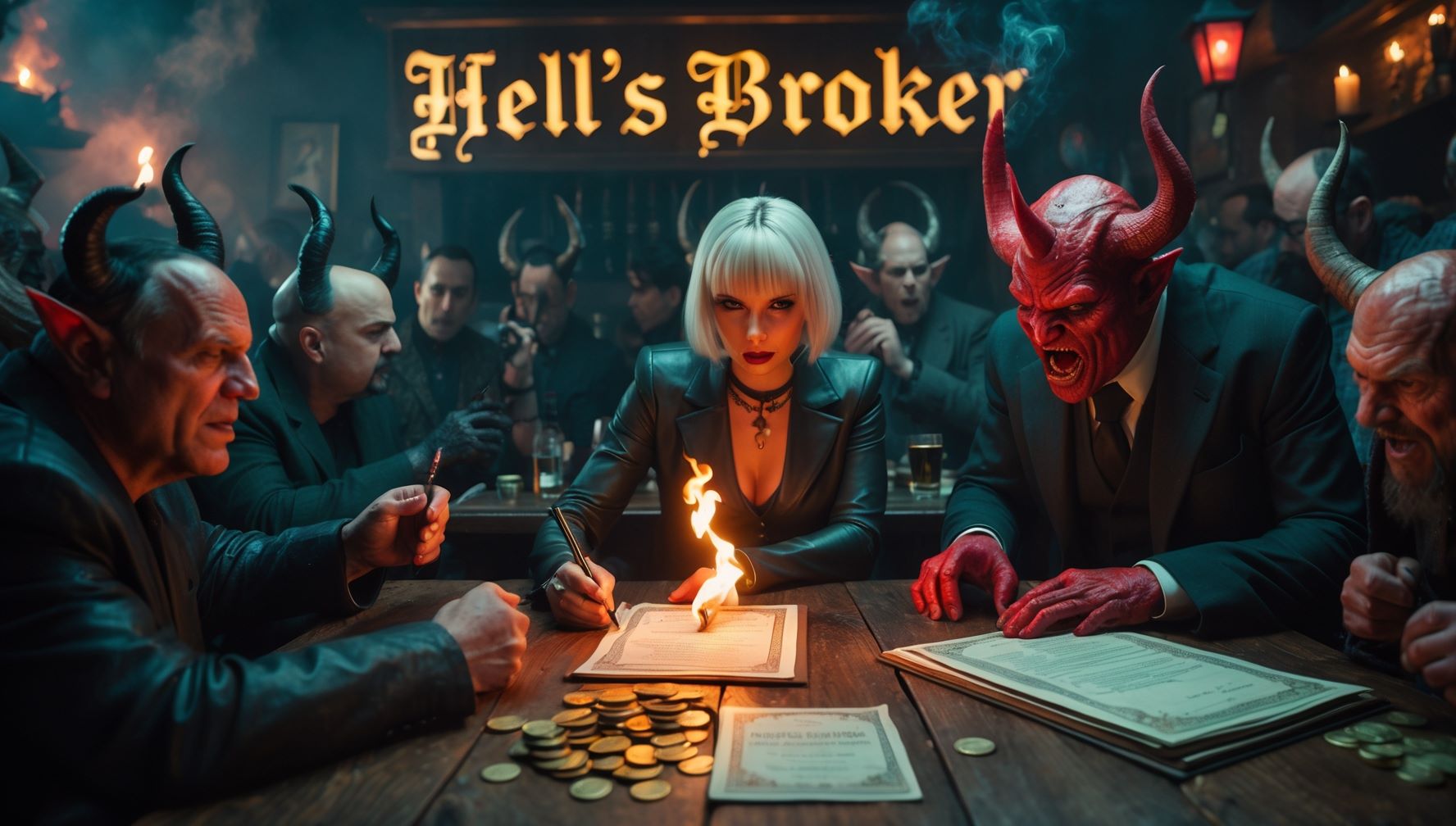
HELL’S BROKER
No Such Thing
As Nowhere
New to Hell’s Broker? Start here.
At twenty-one, Larissa Osborn returns to the mortal world with a bag of tattooing tools, an imp in her coat, and an address connected to her mother. Baltimore is supposed to be a place to begin again.
But old bargains have soaked into the brick. The city has a history beneath its history, and Larissa can feel it in her ink. With Loki at her side, she follows a lead into a world where earning a living, protecting her people, and understanding her past refuse to remain separate jobs.
This is the beginning of Larissa’s story: street-level supernatural noir, dangerous work, and a found family with claws.
A note on reading order: the original Hell’s Broker serial material now belongs to Book Five. It remains available below, but No Such Thing As Nowhere is the recommended starting point.
A field guide to the wrong side of the Veil
Meet the woman who wears it, the people who taught her what loyalty means, and the worlds that make every bargain dangerous. These introductions keep the story’s major discoveries off the page.
Larissa Sabine Osborn
Larissa knows how to read a working, assess a threat, and notice what a client has carefully left out. The harder problem is deciding what kind of life to build with those skills.
Raised in Pandemonium, she comes to Baltimore carrying more than infernal training. The imps who raised her gave her a sense of obligation that does not depend on a seal, a title, or anyone’s permission. She remembers who helped her. She notices who is being used.
Her tattoos are tools, defenses, and a history she carries on her skin. They do not make her untouchable. The wrong working can still hurt her. The right choice can cost more.
Ink and consequence
Tools. Materials. Geometry.
And the skill to know what must not go wrong.
I
Power has a source.
Prepared inks, binders, and supernatural components are not interchangeable. A working depends on what goes into it, not merely the shape someone copies.
II
A mark must do real work.
Larissa reads, prepares, inks, and repairs. The geometry has to hold, the tools have to be right, and the skin or working surface is part of the process.
III
No effortless spell button.
A working can bring heat, pain, strain, or depletion. Different marks have different triggers and limits. Having the tattoo does not remove the need for judgment.
Tattoo magic is part of the world’s economy as well as its violence. The question is not only what power can do, but who supplies it, who can afford it, and what obligations come with the work.
The Tattoo Codex
A spoiler-light selection. Not a complete inventory of everything Larissa will carry.
01
Perception · Upper right shoulder
An early-warning mark that helps Larissa read hostile presence, possession pressure, concealed wards, and unstable magic. It can run quietly or receive her focused attention.
The limit: A warning is not a perfect explanation. Dense supernatural interference can blur the source; sustained reading is taxing.
02
Anchoring · Along the spine
A chain-form glyph that helps anchor and defend her against intrusion or forced displacement. It also supports close diagnostic work, letting her read the structure beneath the surface.
The limit: Protection is not invulnerability. Sustained strain registers in the body and can leave a deep, lingering ache.
03
Pain conversion · Above the right hip
A deliberate working that turns pain into kinetic force. It requires a keyed activation; feeling pain is not the same thing as choosing to release it.
The limit: The pain is real, and directing the resulting force demands control. A large discharge can leave her unsteady.
04
Directed force · Back of the left hand
A mark adapted from Djinn work for force blasts and impact dispersal. Its focus geometry turns raw power toward a chosen target.
The limit: Heavy use burns through the hand and wrist, requires recovery, and can temporarily compromise control of the arm.
Origins, later acquisitions, and story-specific changes are left for the books. These are introductions to function and cost, not explanations of how the story ends.
The Fractured Realms and beyond
Not every threshold leads to Hell.
Not every way in is a way home.
Mortal physical space. Baltimore’s wet concrete, rowhouses, loading docks, and ordinary lives are real, even where older bargains lie beneath them. “Profane” names the layer, not a judgment on the people who live there.
The boundary is layered, and the Veil-layer overlaps the mortal city. Pressure, sound, color, and visible ward-work can change as Larissa moves through it. Baltimore’s accumulated occult history makes it a nexus, but that does not turn every doorway into a crossing.
Pandemonium is part of the world that raised Larissa: dense with magic, institutions, markets, and imp lives that matter far more to her than official hierarchies suggest. Infernal life is not only a landscape of monsters. It is a place where people work, owe, survive, and raise children.
Farther into the series, the geography extends beyond familiar streets and infernal institutions. These journeys are not simply another name for the Veil-layer or a return to Pandemonium. Crossings and keepers impose conditions; gaining entry does not settle the problem of leaving.
The deeper destinations, bargains, and consequences remain inside the stories. The earlier website lore archive is available separately and clearly marked.
Larissa and the imps
The imps are the emotional center of Hell’s Broker. They have their own knowledge, loyalties, grudges, networks, and ways of getting through a world that expects very little of them and takes far too much.
Larissa’s relationship with them is not charity. They raised her. Their lives are part of her life. Whatever the larger powers call them, she knows who her family is.
Loki
A hoodie, hooves, mobile ears, and an opinion about the travel arrangements. Loki is Larissa’s companion and family, not an accessory to her magic.
He talks, notices, improvises, and gets under her guard. Under the performance is someone who knows when she has finally given him the real answer.
The wider community
Waypoints, messages, favors, and people who remember. The imp community has a life beyond any single Broker’s assignment, with its own practical intelligence and stakes.
Its members are not waiting to become important because Larissa notices them. They already are. The books ask what happens when the powerful can no longer afford to ignore that.
Bargains, brokers, and bad debts
Infernal business runs through contracts, materials, enforcement, and access. A Broker works between worlds and interests, where being useful can be nearly as dangerous as being in debt.
Larissa’s work puts her near the people who benefit from those arrangements and the people who pay for them. Reading a contract is one skill. Recognizing what its official terms leave out is another.
That tension runs through the series: what you owe, what you agree to, what someone else claims to own, and what you refuse to trade.
Reading order · Book Five
The earlier-published material is now positioned as Book Five. New readers should begin with Book One above.
These are the preserved original serial links, beginning with “First Cut.” They are later-series material, not a second recommended starting point or a newly revised Book Five edition.
Earlier website lore
These previously published articles are preserved as an archive. They may contain later-story material and earlier versions of the lore. The Book One introduction above reflects the current starting point.